





Henssler Money Talks
Your trusted resource for your money, your future, your life.
October 24, 2026
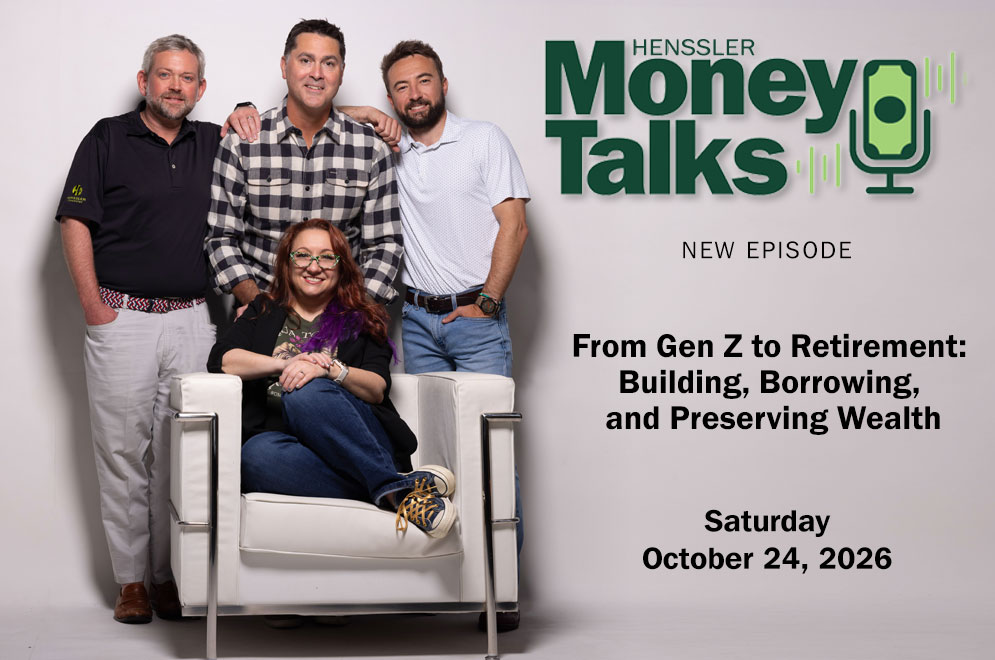
October 24, 2026: From Gen Z to Retirement: Building, Borrowing, and Preserving Wealth
Gen Z: Financially Behind or Financially Different; Mortgage Qualification in Retirement: When Assets Matter More Than Income; The Ten Year Rule: When History Puts the Strategy to the Test; Fixed Income: More Than Just Yield
Subscribe to the Podcast






Featured

The Hidden Trade-Offs of Values-Based Investing
Investing according to your personal values may sound straightforward, but excluding certain stocks or industries can have unintended consequences for your portfolio. From limiting diversification and investment opportunities to navigating the complexities of ESG ratings and mutual fund holdings, the “Henssler Money Talks” hosts examine the trade-offs of values-based investing — and whether avoiding a company's stock actually influences its behavior.
Henssler Money Talks - October 24, 2026
Gen Z: Financially Behind or Financially Different?
Is Gen Z facing a tougher road to financial independence, or have expectations of financial success changed? Some young adults believe homeownership and wealth building are out of reach, while others expect six-figure salaries and an affluent lifestyle right out of college. Still others are counting on an inheritance to secure their financial future. But how does Gen Z actually compare with previous generations at the same age? Whether Gen Z has it harder or not, parents still want to give their children a financial head start. We examine what they can do that can build financial independence rather than dependence.
Mortgage Qualification in Retirement: When Assets Matter More Than Income
You may have millions of dollars in investment assets and more than enough wealth to purchase a home, but qualifying for a mortgage in retirement isn't always straightforward. Without a traditional paycheck, how do lenders determine whether you can afford the monthly payments? We're joined by Shanna Squires to discuss how lenders evaluate retirees, including asset-depletion mortgages, retirement account distributions, and why having substantial wealth doesn't necessarily translate into an easy mortgage approval.
The Ten Year Rule: When History Puts the Strategy to the Test
Over rolling 10-year periods, the stock market, as measured by the S&P 500 Index, has historically been higher more than 90% of the time. But what about those rare periods when it wasn't? A listener asks us to revisit the market downturns that challenged that historical trend and explain how our Henssler Ten Year Rule helped investors navigate them. We look at what happened in the markets, why maintaining 10 years of liquidity can help investors avoid selling stocks during a downturn, and how the strategy played out during one of the most difficult decades for investors.

We discuss financial planning encompassing spending, saving, taxes, investments, insurance, retirement, estate plans, and more.
You’ll find us on all major platforms, including
Apple Podcasts, Spotify, iHeartRadio, Amazon
Music, and here at HensslerMoneyTalks.com.